I've always dabbled in writing. Recently, I got an idea that I couldn't shake. It's turned into an itch that won't go away. There will be graphic sex, violence, and just all around fun. Some parts are going to piss people off. That almost caused me to put the breaks on. Then I thought about all the authors I enjoy reading and thought, "Fuck it."
It's first person PI/Men'sAdventure/Thriller/etc. influenced by Mickey Spillane, Mark Greaney, John Ringo, Robert Crais, Michael Connelly...you get the idea.
I don't know when the rough will be finished, but I am having a lot of fun writing it. Here is a sample (tentatively rough Chapter 2) of Tragic City:
I took the ramp that skirts the Expessway and then exited onto I-20E/I-59N. On either side of the interstate is the urban sprawl of industrial sites mixed with rundown residential neighborhoods and the ever present green of Birmingham’s trees. Birmingham calls itself Tree City USA as well as the Magic City. A satellite view of the city will show you why the former came about, as Birmingham seems to always be on the verge of being swallowed up by looming foliage outside of downtown.
I continued up the combined interstates until they split just past the Birmingham-Shuttlesworth International Airport, continuing north on I-59 towards Trussville and Clay as I-20 curved away towards the east and Atlanta. Another few miles and I exited the interstate and turned right onto North Chalkville Road headed toward downtown Trussville. I took the very next right and pulled into the parking lot Waffle House on the corner.
I eat at this particular Waffle House so often that the waitresses and short order cooks know me by name. I locked up the Mustang and walked inside. I pushed my sunglasses up on my head as I walked through the door and headed for my usual seat at the far end of the counter where I could keep an eye on the entrance and most of the diner.
“Hi, Darlin’,” greets Allie, a wrinkle faced grandmotherly woman with Coke bottle bottom glasses. “The usual?”
“Yes, Ma’am,” I said. I looked around the diner as Allie called my order out to the cook. There was another man at the opposite end of the counter nursing a cup of coffee while perusing a newspaper and chewing on the end of a straw like he missed the days when one could smoke inside. A family of four, Mom, Dad and two little girls, where devouring waffles in a booth off to my left. It was a Tuesday and the place was kind of dead just before ten in the morning.
“Here you are, Hon,” Allie said as she sat a glass of Coke down in front of me. “Food will up in a minute.”
“Thanks, Allie,” I said and took a sip. My phone vibrated in my pocket and pulled it out and glanced at the caller ID. It was a guy I knew, not exactly a friend, but more than an acquaintance.
“Hello,” I answered.
“Hey, Man, it’s Steve,” the caller said. Steve had lived in the South forever, but he’s still got a trace of New York in the accent.
“What’s up, Steve?”
“Not much,” he said, making small talk. Steve was never quick to get the point. “What’s up with you?”
“About to eat some breakfast,” I said as Allie sat two plates in front of me, one holding a larger order of hashbrowns and two eggs over medium with toast. A smaller plate held two sausage patties. I moved the toast over to the sausage plate and liberally coat the hashbrowns and eggs with salt, pepper, and ketchup.
“Well, I won’t keep you from your breakfast,” Steve drawled. “I just wanted to see if you’d be in the shop today?”
The “shop” as everyone calls it is the Blueline Cigar Company. The owner was a medically retired Birmingham cop and the place had become a sort of clubhouse for local cigar smokers. At least the ones with any taste. The shop was in an old house converted to retail space with one room converted into a walk in humidor, two large rooms with wall mounted tvs and an assortment of leather chairs, a full kitchen, and a dining room converted into a card room. On any given day there was a group of salty old men at the card table playing ten cent a chip Limit Hold’em. Bigger games could be had, and these were the men to help you find them, but this was a fun and profitable little game for the skilled player looking for a low stress game.
“Yeah, I’ll be in a little later,” I told Steve.
“Cool,” Steve said. “I got a little work you might be interested in. We’ll talk about it when you get here.”
“Sounds good,” I said.
“Later, Man.”
I ended the call and returned the phone to my pocket, then I dug into my food as I wondered what Steve might need. My stock in trade was usually damsels in distress and elderly folks wanting the meth labs and crack dealers out of their decaying neighborhoods.
Before that dip shit in Atlanta T-boned me I had been making a good living as a cable guy. Yeah, sounds like a weak sauce job which is why it is so high paying if you’re willing to travel a bit and put in some real effort. In truth it was hard work and I fucking hated it but the money was so damn good that you couldn’t just walk away.
After the accident and the city’s settlement I could support my lifestyle without that fucking job so I told the boss I was hanging it up. I was all set to settle down to a life of good cigars and good bourbon while pissing away the hours at the poker table when my Doc reminded me that I should probably stay active if I wanted to stay out of a wheel chair. I decided to fulfill a life long dream and spent two years on the road going to all the big gun and self defense schools around the country and training with all the big name trainers. Gunsite, Thunder Rance, Massad Ayoob Group, SouthNarc, Larry Vickers, Ken Hackathorn, Michael Janich. If they had a name in the gun or self defense world, I was there. Between training courses I started shooting a lot of pistol competition, mostly IDPA, and a little two and three gun.
When I came home I found that there wasn’t much to do but go to the range or sit at the shop. I shot a couple of matches every month but mostly sat on my but for the first couple of months. After a while word got around among friends and acquaintances that I knew some stuff and I started getting asked for favors. I rode shotgun for a few friends repossessing cars and did some escort work for some business owners who carried a lot of cash but didn’t feel up to defending themselves.
This morphed into a kind of Have Gun, Will Travel kind of career. I registered an LLC and got some insurance and put myself out there as a consultant and trouble shooter for average people. Unlike Paladin, my prices are a lot more reasonable, but I am just as selective about my clientele. I don’t work for criminals or non-criminal scumbags. A lot of what I do is just riding along when someone is going to buy or sell something for a lot of cash. People get set up all the time for robberies through online classifieds, so a concerned person can spend a few bucks and have someone with them to look out for a potential set up.
My favorite jobs are those where I make abusive ex’s realize the error of their ways. I’m only for hire in that situation when a court issued restraining order is in place, but when it is I love to come in and show a lady how to look out for herself and give her a little defensive training. I’ll also sleep on the couch for a while if there is a strong chance of the ex showing up early on. The look of absolute fear on the faces of some of these cowards when I open the girlfriend or ex-wife’s door and remind them that they are in violation of a restraining order while holding a shotgun under their noses almost makes me want to do the work gratis. Almost.
That said, I don’t consider myself a gunfighter or anything like that. After all, I’ve never been in a gunfight. I pepper sprayed a young lady’s ex once outside her work when he thought he’d show her that I was no protection from some MMA wanna-be. She did more damage when she kicked him in the balls while he rolled on the ground trying to rub the burning from his eyes, and he was crying like a little bitch when the cops picked him up.
I finished my breakfast and paid with a twenty, telling Allie to keep the change. She beamed and told me to come back soon. I smiled and waved as I made my way out the door, and a couple of minutes later I was rumbling down North Chalkville Road toward Highway 11.
Thursday, July 9, 2015

Monday, April 6, 2015
On The Range #100: Shooting the FN SCAR 5.56 and the Smith&Wessson M&P15 300AAC Blackout
I was given the opportunity to take a trip to one of the local shooting ranges and put some rounds down range through a couple of rifles I had no prior experience with, but which I had wanted to shoot for a while.
First up was the FN SCAR chambered in 5.56x45. This is a rifle that was created as an alternative to the popular AR type rifles. The goal was to create a more reliable, more ergonomic rifle to the replace the venerable M16/M4 rifles commonly found in US and NATO armories.

I'm cross eye dominate, meaning that I am right handed but left eye dominate. I shoot pistols right handed but long guns I shoot left handed. The SCAR is perfect for someone like me because of the ambidextrous controls. The charging handle can be be set up on either the right or the left, and you've got ambidextrous safety and magazine release.
If you can shoot an AR type rifle, you can shoot a SCAR. The biggest thing to be mindful of is to keep your hand out of the way of the charging handle while shooting as it's a moving part you don't have on the AR.
The SCAR I shot had an aftermarket Eotech red dot sight installed. This was my first time with the Eotech sight (I am an Aimpoint fan boy) but I had not issues or complaints.
My ammo options were limited because I had to use range ammo as this was a rental gun, so I ended up using cheap steel cased Tula ammunition. I put 60 rounds through the rifle without any hiccups, so this gun will eat even the dirty stuff (a benefit of the SCAR's piston system vs. the standard AR's direct impingement).

Bear in mind I was shooting cheap ammo so grouping was looser than I would like (and I'm not the best shot anyway). The indoor range I was shooting at had a 50 yard rifle range with a minimum of 25 yards. My first 3 shots are on the lower left pelvic area taken at 25 yards. I was holding on the white dot and the sight was zeroed at 50 yards. Not a great group, but not bad for first time shooting that rifle, offhand, with cheap ammo.
Most of my shooting was done at 25 yards but I did some at 50 as well. I was able to keep all of my shots on the scoring area and most in the vital hit zones. The trigger had a noticeable reset and I found double and triple taps were no problem. Trigger was about the same as you'd get on any milspec AR type rifle or carbine.
The SCAR was a fun gun to shoot, and if I had the disposable income I would pick one up in heartbeat. In the market for a SCAR? Check out GRAB A GUN. They've got a HUGE online inventory and can ship to your local FFL. Oh, and one of the best parts? They finance. So maybe that SCAR isn't so far out of my reach....
But it will have to get behind the Smith&Wesson M&P15 in 300 AAC Blackout! Wow, did I love shooting 300 Blackout! I've already bookmarked the M&P15 upper on GRAB A GUN.

The 300 AAC Blackout was created by Advanced Armament Corporation to be a dedicated suppressor round. Now, that doesn't mean you can't shoot it unsuppressed because that is all I did today. But if you're interested in adding a suppressor to your long gun at some point in the future, this is a round designed to excel from the ground up in that role.


Looking at the target above that one large hole is the first group I shot at 25 yards from the bench. Sure, someone out there can easily do that at 100, but for me that is great. The rest of the shots are from off hand shooting.

First up was the FN SCAR chambered in 5.56x45. This is a rifle that was created as an alternative to the popular AR type rifles. The goal was to create a more reliable, more ergonomic rifle to the replace the venerable M16/M4 rifles commonly found in US and NATO armories.
I'm cross eye dominate, meaning that I am right handed but left eye dominate. I shoot pistols right handed but long guns I shoot left handed. The SCAR is perfect for someone like me because of the ambidextrous controls. The charging handle can be be set up on either the right or the left, and you've got ambidextrous safety and magazine release.
If you can shoot an AR type rifle, you can shoot a SCAR. The biggest thing to be mindful of is to keep your hand out of the way of the charging handle while shooting as it's a moving part you don't have on the AR.
The SCAR I shot had an aftermarket Eotech red dot sight installed. This was my first time with the Eotech sight (I am an Aimpoint fan boy) but I had not issues or complaints.
My ammo options were limited because I had to use range ammo as this was a rental gun, so I ended up using cheap steel cased Tula ammunition. I put 60 rounds through the rifle without any hiccups, so this gun will eat even the dirty stuff (a benefit of the SCAR's piston system vs. the standard AR's direct impingement).
Bear in mind I was shooting cheap ammo so grouping was looser than I would like (and I'm not the best shot anyway). The indoor range I was shooting at had a 50 yard rifle range with a minimum of 25 yards. My first 3 shots are on the lower left pelvic area taken at 25 yards. I was holding on the white dot and the sight was zeroed at 50 yards. Not a great group, but not bad for first time shooting that rifle, offhand, with cheap ammo.
Most of my shooting was done at 25 yards but I did some at 50 as well. I was able to keep all of my shots on the scoring area and most in the vital hit zones. The trigger had a noticeable reset and I found double and triple taps were no problem. Trigger was about the same as you'd get on any milspec AR type rifle or carbine.
The SCAR was a fun gun to shoot, and if I had the disposable income I would pick one up in heartbeat. In the market for a SCAR? Check out GRAB A GUN. They've got a HUGE online inventory and can ship to your local FFL. Oh, and one of the best parts? They finance. So maybe that SCAR isn't so far out of my reach....
But it will have to get behind the Smith&Wesson M&P15 in 300 AAC Blackout! Wow, did I love shooting 300 Blackout! I've already bookmarked the M&P15 upper on GRAB A GUN.
Wicked looking round!
Shooting an AR in 300 Blackout is a pure treat. The recoil is similar to a pistol caliber carbine and accuracy is excellent. My only regret about shooting the 300 Blackout is that I couldn't afford to take it home with me.
Two groups shot at 50 yards.
So, this gun is going on my "BUY SOON" list. It was fun to shoot, and I shoot it better than I would have thought. I think 300 Blackout has the potential to be a great all purpose round. I have friends that swear buy it for hog hunting and I have no doubt it would put a white tail in the bed of your truck. And lets face it, if it'll do that it'll work great as a self defense tool. Not too mention it's great a round to be shooting if you're running a suppressor which is something I am seriously going to be looking into in the future especially since Alabama, like a lot of states, allows suppressor hunting.
If 300 AAC Blackout is a something you've been considering I say go for it. Check out GRAB A GUN. Not only do they have the gun I shot today in stock, but they've a ton of other rifles and uppers chambered in 300 AAC Blackout.
As you may have guessed by now this post was sponsored by GRAB A GUN. They gave me the opportunity to shoot some guns I have not touched before and all they asked from me was to blog about it and mention them as a source to fill your firearms needs. Go check out their website. They've a huge selection of firearms, both handguns and long guns, and they even offer financing for your next purchase.
Monday, March 30, 2015
A contrast in quotes.
"The blade itself incites to deeds of violence." -Homer, Poet
"I do not love the bright sword for its sharpness, nor the arrow for its swiftness, nor the warrior for his glory. I love only that which they defend." -J.R.R. Tolkien, Author and veteran of the Battle of the Somme
Humans need no weapon to act violently, but a weapon certainly helps to defend against violent attack better than bare hands, feet, and teeth.
Thursday, September 11, 2014
On The Range #97: Shootrite Firearms Academy Defensive Handgun, Day 2

Day 2 of Shootrite's Defensive Handgun course began at 8;30AM on the Shootrite range.
We started out with a discussion of the importance of practice, and specifically dry practice. Practice does not have to be shooting. You can practice draws, dry reloads, sight alignment, and trigger control without ever sending a round down range. You can learn more from dry practice because you will focus on the details and performing every action as close to perfect as you are capable of doing it. As Tiger McKee said, "You'll never be perfect, but you can strive to be excellent."
On the firing line Tiger had us do a mental exercise with the goal being to come up with an instant response. First he asked us to answer a difficult math problem. When no one answered but instead started to think about it he told us we didn't need a perfect answer, but an immediate one. He then started asking us individually a rapid fire list of questions with the goal of getting an instant appropriate response. For example, if asked your favorite color, movie, or food he was expecting an instant response in the correct category. Blue should not be your favorite food, nor pizza your favorite color.
The idea here is that when presented with a threat you want to act in such a way as to force that threat to react to you, instead of reacting to the threat yourself. This was a recurring theme of the course.
We picked up where we had left off on Day 1 with movement. Starting dry we practiced moving to the right and left on the firing line. When moving right or left, the right leg leads right and the left leg leads left.
After we had moving dry down we added in the draw. As we moved either right or left we would draw our pistols out to either low ready or on target to the threat. We were encouraged to do this very slowly, focusing on doing everything consistently and correctly.
Next we moved into live fire. On command we would step left or right while completing a draw, give commands to the threat, and if not obeyed (cardboard just won't listen!) we would 'gain compliance with accurate shots.' We would then scan our surrounding for additional threats while slowing working our pistols back into our holsters.
While scanning it was very important to actually see, not just glance around. The details matter. The instructors would ask us questions about things they had been doing with their hands or objects they had been holding to make sure we were actually paying attention as we scanned around.
We continued live fire for a while, taking breaks to reload. We worked on transitioning our fire to places other than center mass like the pelvic zone or head.

We took a morning break and afterwards moved into a discussion of malfunctions and malfunction clearances.
Malfunction clearances are a part of functional (combative) manipulations. They need to be performed immediately. It is important to practice them slowly and consistently, so that you will do them correctly in a fight.
Tiger likes to put malfunction clearances in simple terms. To handle them you either need to load the gun or unload then load the gun. "If I press the trigger and it doesn't go bang I need to load the pistol. If that doesn't work I need to unload it and then load it." This makes sense if you remember his method for both loading and unloading a pistol.
He explained clearing the three common malfunctions:
Type 1 Malfunction:
You press the trigger and the gun does not fire, you get a click
1. Finger off the trigger
2. Tap the magazine to ensure it is properly seated
3. Aggressively cycle the slide to load
Type 2 Malfunction/Stovepipe:
You press the trigger and the gun does not fire, trigger may or may not be reset, you'll generally see the brass or round that failed to eject.
1. Finger off the trigger
2. Tap the magazine
3. Cycle slide aggressively to clear the brass and load a round
Type 3 Malfunction/Double Feed
You press the trigger and get a dead trigger
1. Finger off the trigger
2. Tap the magazine
3. Cycle the slide aggressively AND IT WILL NOT CYCLE
4. Strip the magazine and retain it in the pinky finger of the strong hand
5. Cycle the slide three times very aggressively
6. Load the magazine and cycle the slide to load a round
We practiced clearing all three types of malfunctions live. For Type 1 malfunctions we used dummy rounds. We broke up into pairs for Type 2 and 3 malfunctions and had the non-shooter either place spent brass in the ejection port or drop a live round into the chamber to set up a double feed.
I've never practiced malfunctions clearances much so this was fairly new to me. I think it was well worth the time and I plan on working on it in my own practice.
After this we took a lunch break, again at the South Sauty Cafe. Again, the bacon cheeseburger. Because it IS that good.
After lunch Tiger told us that things had gone very well so far and as a result we were going to get into some things that normally aren't covered in this particular course.
We broke up into two groups. Half of us (my group) went with Tiger to another part of the range set up with a long wall of different types of cover and some steel torso targets. The other half went with Tiger's co-instructor to the area where we had been doing our shooting so far.
With Tiger we worked on using cover while shooting. The big thing here for me was learning to slow down. Everything in IDPA is done using cover but also in a rush. The idea here was to shoot the threat, scan the environment, then move looking for other threats along the wall we were using. This was where I had the most fun in the course because it was very similar to the run and gun games I like.
Early on when we started on the live fire I asked if I should shoot on the move, or move and then shoot. Tiger said that if cover is just a few steps away that it would, in his opinion, generally be better to get behind cover and shoot from a stable stance than to potentially have a miss just to get a shot off quickly.
One thing that Tiger teaches that I had been told to do in IDPA but ignored was to reload while keeping your gun and eyes on your target rather than to get back behind cover. I had figured that the IDPA way was a good way to catch a bullet. Tiger pointed out that keeping your eyes on the target was a good idea because then they could not move without you knowing where they were going. There was a caveat, "Incoming rounds always have the right of way."
When using cover we were taught to expose the least amount of our body as possible to locate, identify, and if necessary engage the threat. Tiger recommended using mirrors to practice this in the home.
Next the two groups switched and my group went with Tiger's co-instructor, Matt. With Matt we worked on two things, moving backwards and blind malfunctions clearances.
First we worked on moving back dry. We started with a step, and then two to three steps at a time. Matt had us move over a lot of different terrain, even into brush and up a slope just so we could see out obstacles that you can't see can be very difficult to handle and tend to seem larger than they actually are when you have only your feet to sense them. We also worked on moving while keeping our sights on target. This is probably one of the more difficult things to do. I've actually got a lot of practice shooting while moving back thanks to IDPA and Frank Proctor's Performance Handgun course.
We culminated our live fire by starting close and then shooting while moving back about 15-20 yards. The goal here was to show us that our shooting would start fast, but that as we moved further back we would have to slow down to keep getting good hits and eventually we would reach a point where we would have to stop shooting. The stop point would be different for everyone but it's a good thing to know about yourself.
After finishing up with moving back we took a short break for a drink and ammo, then moved back to the firing line for blind malfunction clearances. Matt had us draw and deck our pistols. Then we would take a few steps and turn our backs while he set up a malfunction on each of our guns. He asked that even if it were obvious to treat it as if we didn't know what the issue was.
On command we turned, retrieved our gun from the ground, and then engaged a threat target with 2-3 rounds. I had to clear every type of malfunction, and even a new one. One time when I picked up my pistol everything seemed fine, but when I fired the magazine fell out. This required a reload and was to simulate not seating a magazine correctly and it getting jarred out when firing. Good times.
Finally, we wrapped up our range time and headed back to the classroom for a discussion on tactics and the legality of armed self defense.
Tiger told us it is important to pay attention to what is going on around us and that if faced with a threat we should first try to get away, second maximize our distance between ourselves and the threat, and third minimize ourselves as targets and use cover. He again emphasized making our threat respond to us by taking immediate action.
Then he got into the legalities. In general, in order to defend yourself with lethal force the threat you are faced with must display the intent, have the ability, means, and opportunity to cause grave bodily harm or death to you or anyone you have the right to defend.
For instance, a person with a bat threatening your life at 50 yards probably is not an immediate threat justifying lethal force. The same person at 20 feet, however, is because they can close that distance in less than 2 seconds.
Normally, for a person to be considered a lethal threat they must be armed. However, disparity of force comes into play if a person or person's can bring enough force to be a lethal threat even if they are unarmed. Large, muscular man vs. smaller man or woman, group vs. a single person, etc.
Again, Tiger said what we had to do was problem solving at high speed. He recommended that we ask ourselves, "If I don't use my gun now is myself, my family, or my friends facing serious bodily harm or death?"
We moved from here into a discussion of the aftermath of using lethal force in self defense. He encouraged us to be able to articulate that we were attacked and defended ourselves and that when LEOs arrived we should immediately identify ourselves if possible and comply with all of their orders.
He recommended that when asked what happened to say "I was in fear for my life(or another's)." Don't get into a detailed discussion right after because the details can be fuzzy because of the stress of the situation. You might experience Critical Incident Amnesia and you usually won't have complete, or as complete as possible, recall until you've gone through at least two sleep cycles.
Keep conversations with any and all authorities simple. "That person attacked me. I want him arrested. I will fully cooperate but I need to speak with my attorney first." You may get questioned by multiple officers. Always, and only, reiterate the above until you speak with your attorney.
He also said we should seriously consider consulting with an attorney and having one picked out now before any kind of incident happens.
After this discussion and some question and answer Tiger thanked us all for attending and said it was a really great class and that that was not something every class heard. He presented us with our certificates for the course and that was that.
I really enjoyed the course. It's a great course for anyone who wants to learn how to defend themselves with a handgun. This is a basic defensive course, but it is not for the new shooter. An NRA First Steps Pistol course is the minimum requirement for attending but I would definitely recommend Basic Pistol. You really need to know how to safely handle your pistol on the range with some confidence.
I plan on taking more of Shootrite's handgun courses and I hope to take some carbine courses there as well. I will definitely be heading back!

Monday, September 8, 2014
On The Range #96: Shootrite Firearms Academy Defensive Handgun, Day 1

Shootrite Firearms Academy's Defensive Handgun course started at 8:30AM in the classroom. Tiger McKee, the director and founder of Shootrite, started out by introducing himself and his co-instructors to the seven course attendees. Attending were myself, three other men and three women. I was the youngest attendee, something that kind of surprised me. I thought the fact that almost half of the course attendees were women was interesting. Most of the attendees (at a guess) were 50+.
Tiger started out by explaining that the overarching theme of this course was consistency. Fast is his least favorite word. This was a basic handgun self defense course and he wanted everyone focused on doing everything correctly every time in order to get as many good repetitions in as possible.
Next he went into a discussion of safety. Tiger gave an in depth discussion of the Four Rules of Firearm Safety, not just simply stating the rules but explaining why each one is important in detail. He made the point of saying, "Good guys are responsible for everything they do, and must be responsible for where every bullet goes."
One thing that I think was very important that was brought up was that you have to not only be conscious of being safe yourself, but also of the habits of others around you. You can be doing everything right and someone can walk right in front of you. This could be your spouse in a self defense situation or someone shooting on the range next to you. Being aware of the other people around you and what they are doing is very important.
We were told that if we saw something unsafe happening that we should point it out and try to correct it.
After the safety discussion, we moved on to a discussion of The Fight. "Call it what you want," Tiger told us, "but self defense is a fight." Fights, he went on to say, are 90% mental. A fight is problem solving at high speed.
Tiger asked us when a fight starts. For Tiger, a fight starts when he wakes up that day and acknowledges that, "Today may be the day I have to defend myself or my family from a violent attack." The idea is to be ahead of the game so that if something happens you're not in complete denial about what is happening.
The next topic was, when does the fight end? We were taught that the fight ends when legal authorities arrive and secure the scene and there is no chance of anything else happening. Something that I had not considered was that it could be minutes, hours, or days before things are secured. A natural disaster or civil unrest can mean that it can take a long time before authorities can get to you.
Tiger is a big believer in avoidance and escape. If you can avoid a fight or escape from a situation that should always be the choice you take. Fights are like car accidents. They can come out of nowhere. But if you pay attention to what is going on around you most times you can avoid a bad situation before it turns into an accident or a fight.
Next we discussed what happens to us in a fight. We were told to be aware of stress effects such as tunnel vision, auditory exclusion, and loss of dexterity. Tiger recommended with research this thoroughly on our own time.
Tiger explained that most confrontations happen at conversation distance. About 50% of violent encounters involve two or more attackers. Around 70% of violent encounters happen in low light. Another key point was that self defense confrontations happen fast, usually 3-5 seconds. In a violent encounter people are usually familiar with each other in 80% of conflicts (the numbers are slightly higher for women, and slightly lower for men).
In a fight, the only thing you can control is yourself and it is better to act than to react. You should be attempting to make your attacker react to your actions rather than react to theirs. This is why doing something immediately is usually better than waiting. An imperfect immediate response is better than a late perfect response.
Next we discussed the elements of marksmanship. We shoot to stop the threat. Shooting them in the best manner to stop them may mean that they die as a result, but killing them is not the goal. Stopping our attacker is the goal.
Accuracy in a defensive encounter is defined by distance to and size of the target. You need to be sure you are doing what you need to do in order for your bullets to go where you want them too. This is why consistency is so important. You need to know exactly where your bullet is going every time you press the trigger and doing things consistently is how that happens.
We discussed the steps of taking the shot: Aim, hold, press, follow though. Follow through is probably one of the most important steps because you may need to take multiple shots and follow through sets you up to be able to do so correctly.
Tiger explained that we shouldn't get too caught up in "shooting the bullet." That's the guns job. Our job is to point the gun in the right direction and smoothly press the trigger He also pointed out that speed is going to be dictated by the accuracy necessary to make good hits. The closer you are to the target the faster you will be able to shoot.
We were taught three zones on the the body we should be aiming for in a defensive encounter. Our primary target is center mass of the chest. This is the largest part of the body available where we can put rounds that will stop an attack. However, people can and do sustain damage here and keep coming. Body armor can also be a concern. Therefore, the secondary zone on the body Tiger advocates shooting is the pelvic area. A lot of blood flows through this part of the body and it is a key structure needed to keep a person on their feet. A good hit to the pelvis can put a person on the ground so that they can not stand back up.
The third zone is the central nervous system, or head shot. Because the human skull has evolved to protect the brain this is a very difficult part of the body to attack. Shots typically need to go into the head via the ocular canal between the eyebrows and the base of the nose. This is why it is typically the last of the three zones to shoot at.
When shooting to stop a threat it is important to put good, accurate hits on the threat until we get the results we want. Consistently operating the handgun is going to be extremely helpful with this.
It's also important to remember that you are shooting at a 3D target and may need to adjust your angle of fire to get those shots where you need them.
After marksmanship we discussed firearm manipulations. There are two types of manipulations, administrative actions and functional actions. Administrative actions are those that can be done at your discretion such as loading, unloading, and chamber or press checks. Functional actions are those that must be performed immediately such as empty reloads and malfunction clearances.
Any gun can and will malfunction under the right circumstances so it is important to know how to handle them and to train to handle them in action. This was covered extensively in Day 2 of the course.
The final topic covered in the classroom was tactics. Situational and environmental awareness are the key aspects to defending oneself. Being aware of where you are and what is going on around you gives you the chance to see something that you don't like and act instead of being on the opposite end and just reacting to something that is happening to you.
You're first goal should be to avoid and/or escape the situation. This is the best response if it is available to you. If not you should be trying to move (distance is your friend in a self defense scenario), communicate (force the adversary to rethink what they are doing with verbal commands), use cover, and if necessary shoot. Any of the steps up to shooting may resolve the situation. If they don't, you'll need to put accurate hits on the threat until they stop.
After our discussion of tactics we took a short morning break and then headed to the range.

The number of participants in each course at Shootrite is limited to 8. This means each individual can get plenty of one on one coaching from the instructors. It also means that a huge range isn't necessary. The range could have probably accommodated twice as many shooters, but with just 7 of us there was plenty of room for everyone to be on the firing line at the same time without crowding each other.
Tiger breaks up the range time with frequent short breaks. This allows the instructors to give short lectures on what we will be doing and allows participants to load mags, re-hydrate, or grab a quick snack between time on the firing line.
We started our time on the range with a lot of dry practice. Since the overall theme of the course is consistency we were told to focus on proper technique. We were encouraged to go as slow as necessary to do everything correctly every time. At no time during the two days were we rushed to finish performing a drill.
First we discussed shooting stances. Tiger is a believer in using what works best for you so he does not advocate once particular shooting stance over another, but rather acknowledges that you may have to shift from one to another as a fight progresses. What he did ask we do is to maintain a good fighting stance with our foot placement and weight forward over our feet.
Next we worked on the draw stroke and holstering. Shootrite teaches the draw in a familiar four step process of: 1. Strong hand grips holstered pistol in preparation to draw while support hand slaps the center chest. 2. Bring pistol up into the retention position, tucked into the body but canted out so that the slide can operate without getting caught in clothing or hitting the body if extremely close quarters shooting is necessary. Support hand remains against the chest. 3. Attain a two handed grip and begin to press out. 4. Press out to low ready if a threat is present or if you have decided you must shoot press out towards the threat until your sights come to your eyes at which point your finger should be on the trigger and taking up slack until the shot breaks.
One thing that I should mention is that Tiger also took the time to demonstrate drawing from concealment. He offers a version of Defensive Handgun where everything is done from concealment, but in this particular course we had the option of using a cover garment or not. For Day 1 I did not use a cover garment but used my Glock 17 in a Galco Royal Guard IWB holster. For Day 2 I concealed my Glock 17 under a polo shirt and used a kydex DSG Alpha OWB that I typically use in IDPA matches.
Along with the draw we also practiced working our pistols back into the holster in a slow, and safe manner. There is no rush to get the gun back in the holster. Tiger teaches that when a threat is gone one should return to low ready (or remain in low ready if taking aim at the threat and firing was not necessary) and scan the area for any other threats. From low ready we were coached to slowly work the draw stroke in reverse while constantly doing a slow scan of our surrounds until we had our gun back in the holster. It was emphasized over and over that there is never any reason to rush this process as a new threat can pop up at any time or the original threat may return.
We next worked on loading and unloading. Loading began from low ready. Keeping the gun in low ready and our eyes up we retrieved a magazine with our support hand and with it properly indexed (base in the palm, index finger touching the first round in the mag) we fit the flat back of the magazine to the flat back of the magazine well on the pistol. The magazine was then firmly seated and the support hand came up to aggressively run the slide to load a round. This is all done with the eyes up. The only time the eyes go to the gun is to perform a visual check that a round is loaded.
Unloading was a more involved process than I have used before. The magazine is removed and retained in the pinky of the strong hand. The support hand aggressively runs the slide at least three times in order to clear any loaded round, and then a visual check is performed. The only time the eyes should come down to the pistol is when doing the visual chamber check.
Confirming clear was done by using the fingers to confirm no magazine is inserted, running the slide three times to remove any round in the chamber, and then doing a final visual check to confirm the chamber is empty. At this point to pistol was worked back to the holster while scanning our surroundings.
As you can probably see the idea is to be able to do all of these manipulations blind so that you can keep your head up and eyes on the move looking for any potential threats. Doing it the same way every time maintains consistency. If you do it that way every time, you'll keep your eyes up and on the threat/s if you are performing an empty/speed reload while in a fight.
At this point we broke for lunch at a very nice local diner called the South Sauty Creek Cafe. They make a great bacon cheeseburger. I highly recommend it if you are taking a course or just in the Langston, AL area.
After lunch we went back to the range for some live fire practice. Before we got into the actual live fire we did an exercise to familiarize everyone with the reset of their trigger. This was done buy breaking up into pairs, dry firing the pistol and holding the trigger all the way to the rear, and having the other person run the slide for you. At that point you would let out the trigger until it resets in preparation for another shot. We did this a few times until everyone got a good feel for their pistol's reset.
We moved on to shooting from the low ready. On the command we would come up from low ready, issue verbal commands to the threat, and then assuming that failed fire the required number of rounds, being sure to take our time and work on reset. We started with a singe shot, and then resetting the trigger. We moved up to multiple shots.
Live fire continued with us working under the assumption our threats were not going down and transitioning to the pelvic region or a head shot as we were instructed. We also did some drills shooting all three zones in various order.
As the day came to a close we were working from the holster, completing a draw, engaging our target, and then scanning our surroundings while working our pistols back to the holster. Everything was done deliberately and slowly with the goal of performing every action consistently every time.
Something new to me was the exercise in which we performed our draw stroke as if we needed to shoot the threat, but with our eyes closed to see what our body felt like when the pistol was pointed correctly. We did this a few times, opening our eyes after the press out to check our sights and make adjustments if necessary. We eventually moved to live fire blind. It was impressive to me how easy it was to get good, accurate hits at close distances. The goal here was to show us that you don't need much in the way of sight alignment, just a flash of the front sight, to confirm you are going to make a good hit when you press the trigger. This was the only time we actually did anything at speed because at such close distance speed really becomes important, but you have to know you can make good hits.
We closed out the day getting the basics of moving left and right (dry) before wrapping things up with a final discussion of what we had covered and why it was important. Every repitition needs to be done correctly every time so that it becomes second nature. In this way you are training your subconscious to do what you want it to do under stress. You communicate with the threat. Many times just making them aware that you are not a passive victim will cause them to back off. If verbal commands don't work you gain compliance by getting good, accurate hits with your handgun. Finally, using movement you get the threat to respond to your actions rather than the other way around.
And that was Day 1. It was largely stuff that I was already familiar with from literature and other training course I've attended but there was definitely some new material and even repeating things I had done before made for a great refresher.
Stay tuned for Day 2.
Saturday, September 6, 2014
A few notes from gun school.
Today was the second and final day of my Defensive Handgun course at Shootrite Firearms Academy. This was a two day basic handgun self defense course. Day 1 largely consisted of things I was already familiar with but was a very good refresher. Day 2 was a lot of stuff I was intellectually familiar with but that I had never put into practice on the range.
I'm going to be doing a detailed post for both days of the course soon but I wanted to make a couple of quick observations.
First was that I was the youngest of the seven people attending the course. I am 29 and the next youngest person there was 36. Most of the attendees were 50+. This actually kind of surprised and disappointed me. I definitely need to recommend that some of my friends get up there.
There were three men besides me, and three women. That was a pleasant surprise. One of the women had just jumped into shooting after Sandyhook. She went from being ambivalent about guns to being extremely pro gun as a direct result of the attempts to limit the Second Amendment.
There were a variety of guns. There were three Glocks (mine, another man's, and one woman's). The other two women were shooting a S&W Shield 9mm and a Sig P250, respectively. One man was shooting an XD and the other an Ed Brown Cobra Carry 1911 (probably the nicest gun out there).
Everyone was shooting 9mm pistols except for the 1911 guy and one of the Glock guys who was shooting .40. No big surprise here.
Everyone shot about 400-500 rounds and there were, to my knowledge, no malfunctions that were not a result of operator error or deliberately induced for training purposes.
Oh, and everyone could shoot. And I mean everyone. This was good because it gave us a chance to advance into some stuff that doesn't normally get covered in this particular course.
All in all I had a good time. I feel like I really took away some good stuff. Tiger McKee, the owner and lead instructor, is a very open minded type. He acknowledges that people may have a different way of doing things and he is ok with that. He said over and over, "This is the way we do it, and the way we teach it. We want you to try it, and if you find it does not work for that's ultimately your decision. As long as what you are doing is safe, I have no issue with that. Just give our way a chance." He also made a point of explaining the "why" of his methods, rather than just saying "this is how it is done."
A couple of the things I probably won't do his way. But he convinced me on at least one thing, and that alone was enough to make the two days worth it.
More to come.
Friday, August 22, 2014
Going to gun school.
September 5th and 6th I'll be in Langston, AL (just outside of Scottsboro) taking the Defensive Handgun course at Shootrite Firearms Academy, LLC. I've wanted to get up there for years and it has finally worked out.
I am really looking forward to this, and I hope to do a fairly extensive write up afterwards.
Thursday, January 23, 2014
Happy John Moses Browning Day!
The inventor of the 1911 and .45 ACP cartridge was born on this day in 1855.

Other notable Browning inventions are the BAR (Browning Automatic Rifle), the Browning Hi Power pistol, and the M2 .50 BMG which is still in use by US Armed Forces to this day.
Other notable Browning inventions are the BAR (Browning Automatic Rifle), the Browning Hi Power pistol, and the M2 .50 BMG which is still in use by US Armed Forces to this day.
Sunday, May 12, 2013
On The Range #86: The Masters 2013 IDPA Match

Yesterday I shot in my first sanctioned IDPA match, The Masters 2013, at Brock's Gap Training Center in Birmingham, AL. It was ten stages of both fun and frustration.
All of the SOs, saving one man on one stage, were great. This one guy stood out as an asshole, but fuck him. The other SOs were wonderful even if they all had a variety of styles and mannerisms.
The stages were all challenging and fun, my favorite being one that was set up to mirror the scene from The Outlaw Josey Wales in which Clint Eastwood comes out of a general store, hands full, to find himself confronted by a group of Union soldiers. As they stare each other down, he says, "Are you gonna pull those pistols, or whistle Dixie?" You, of course, are Wales. That was also probably my best stage overall.
I ended up 16 out of 20 in Stock Service Pistol/Sharpshooter, and 104 of 140 total shooters. I wasn't dead last, so I'm happy about that. I shot about middle of the pack with the SSP/Marksman, which is what I'm used to.
I was almost disqualified on a stage for possibly unsafe muzzle work. One SO saw it, one didn't. The one who didn't decided I could rerun the stage after the stop call. Personally, I'm not sure. The stage required me to back up and then run down the 90 degree line. My muzzle typically goes where my eyes go and I didn't look past the 90. A few of my squad mates spoke with me after and said I was close but didn't break it. Anyway, I was very conscious about it the rest of the day.
Overall, it was a good match. I had fun, but by the end I was exhausted. My allergies were driving me insane. I had a runny nose for most of the match and was eating Claritin at lunch (which helped not at all for once). Match results didn't come out until late and I was in bed by 8:30 last night so I didn't see them until this morning.
The Glock ran perfectly though out the entire match. I the match using Winchester Ranger 127gr. 9mm +P+ JHP, my carry ammo. I bought it for the same price I see PMC 115gr FMJ going for so I figured I might as well use it and have the extra oomph for steel activators.
I'm looking forward to the next club level match later this month, and I may look into shooting a few more sanctioned matches around the southeast.
Wednesday, January 9, 2013
On The Range #81: Way of the Gun Intro to Performance Carbine
This past Sunday I attended my first rifle/carbine training course in Anniston, AL. The course, titled Intro to Performance Carbine, was put on by Frank Proctor of Way of the Gun.
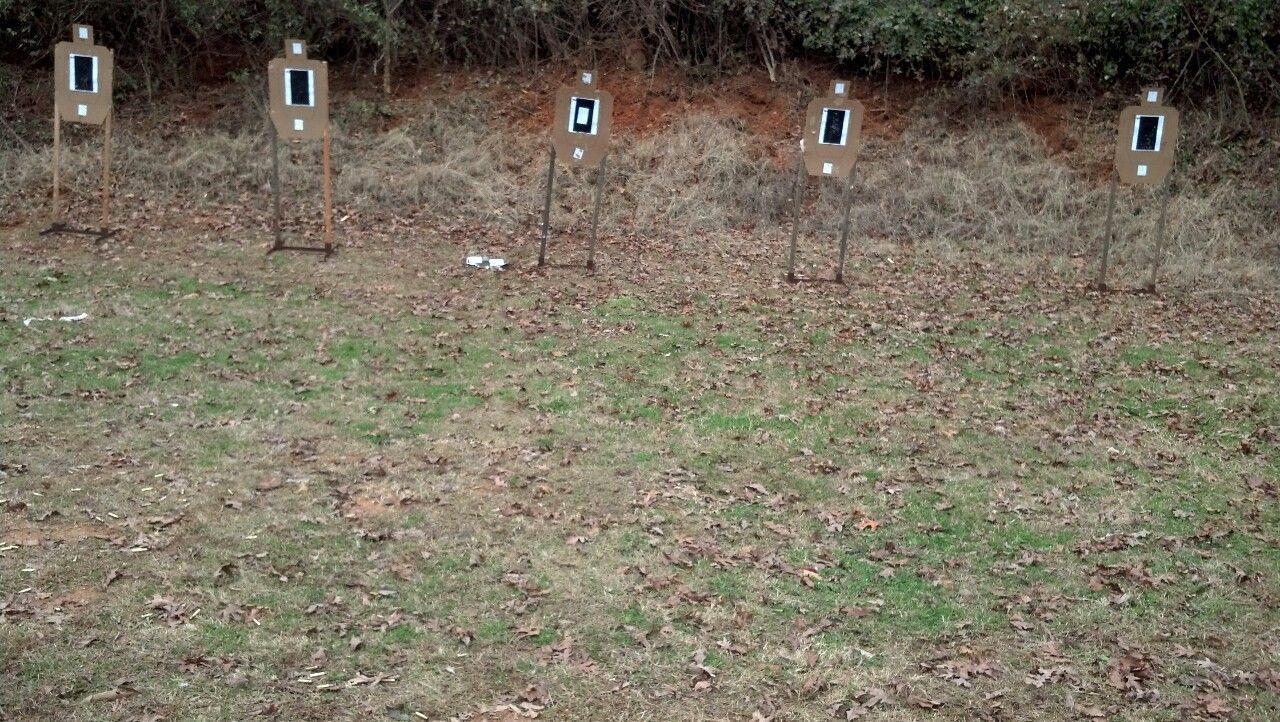
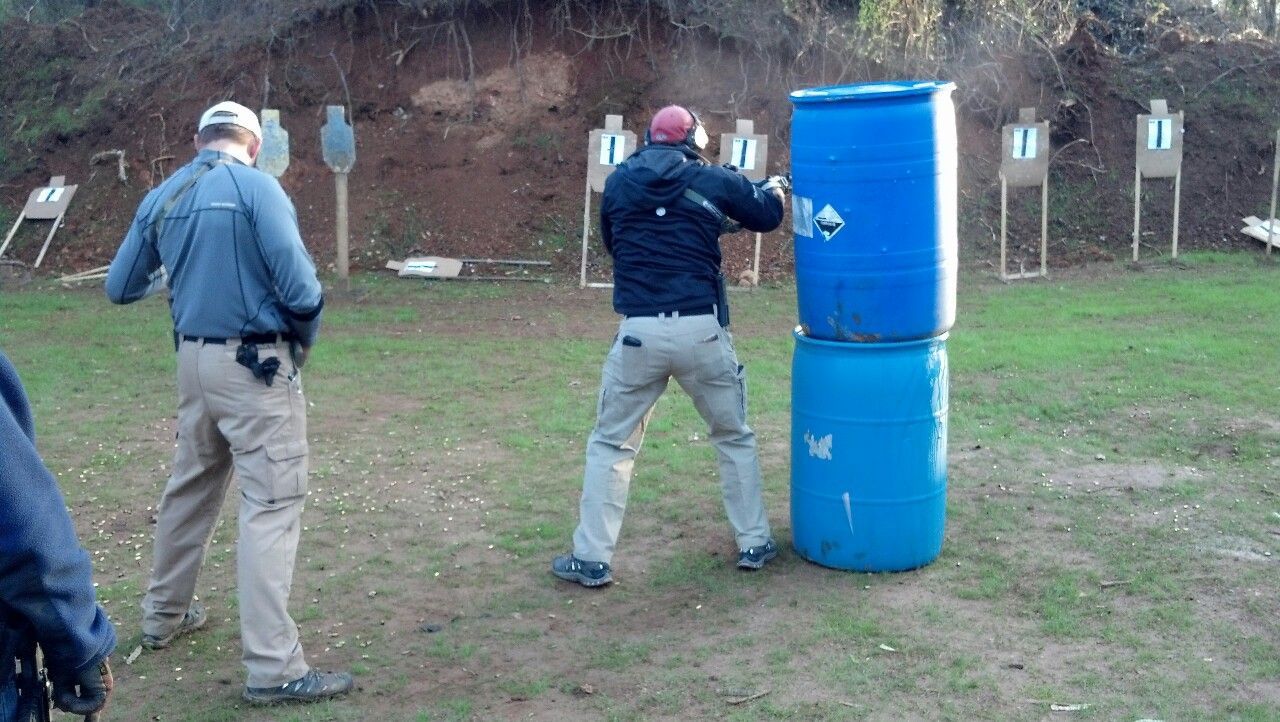
My favorite kind of classroom.
As a result of the latest run on ammunition there were only five students in attendance. This gave each of us a lot more one on one time with Frank as he led us through the day's training.
The course was in many respects a facsimile of the Intro to Performance Pistol course I took a few months back, though very much more tailored to the carbine. All of the fundamentals of shooting were the same, as one might expect.
Frank's philosophy is that whether shooting for competition or shooting to defend yourself the person who scores the most points fastest wins, therefore the focus of the course was on fast and accurate shooting. Frank pushed us to operate our carbines as fast as we were able to make accurate hits.
We worked a number of drills that were new to me. I plan to incorporate a couple into my practice at home (including the reload drill I learned in the pistol course).
One of the drills was the VTAC 1-5 Drill:
As I said before the small class size gave each of us a lot of one on one time with Frank. I found this very helpful as he gave me some tips to improve my shooting with the carbine and pointed out some bad habits I'd picked up.
About to make some steel sing!
Probably the best shooter in the class is in the photo above. His speed and accuracy were really amazing, especially since the rifle he was using was brand new and only zeroed that day. He's a competitive pistol shooter and you could really see that skill cross over onto the carbine.
At $180 I feel like I got my money's worth out of this course. The instruction and atmosphere was great. Frank is a really excellent shooter who wants to pass on what he's learned to others. He has a very positive, approachable attitude and has no problem leaving his ego out of it. As much as he's there to teach he's also willing to learn from others as well.
We finished up the day doing some shooting at steel targets set up at 60, 100, and 140 yards (roughly). I was able to hit the reduced size IPSC tagets at all distances, but struggled with smaller stuff past 100 yards. Still, it was nice hitting anything even at that range.
I took the opportunity to test a few pieces of gear I've picked up. I have a Condor MA1 Tactical MOLLE Drop Leg Platform - OD Green
set up to hold rifle mags that I used for a while. I've used it before and while I like the idea I'm just not a fan of having things on my legs. It's not comfortable and just feels like it's weighing me down. I also used a BladeTech belt mount single mag holder. I found this a MUCH better method for quickly retrieving a mag and much more comfortable.
My Lucid HD7 red dot held up fairly well. Under 50 yards it's great, and it works at distance well. The battery held up all day with no need to replace it. I'm pretty impressed with the batter life. The sight has an auto off after being on for two hours which works like a charm. The only issue I had with it was one of my own making. After almost six hundred rounds it had come loose from the rail. I figure this was result of me not having it tight enough. That's something I'll be sure to keep a check on.
My AR held up very well. I had zero malfunctions related to the gun, and one related to a magazine. The magazine issue was a result of overloading my PMag. PMags will hold 31 rounds but they will usually not lock into the mag well with the bolt forward. Other than this, no issues.
I'd recently started using Slipstream Weapon Lubricant 
on my AR. My gun stayed slick all day even though I was shooting dirty Monarch brand steel case ammo. I did a thorough cleaning, including bolt dis-assembly and relubed with the Slipstream. This stuff will be going on my Glock and 1911 for further testing.
I hope to get some more training from Frank Proctor in the future, and I recommend him to anyone who is looking to get some formal instruction without breaking the bank. I feel like I learned quite a bit that will help my on the past to becoming a better shooter.
Subscribe to:
Posts (Atom)